

Author: Meena Roshnaye, 2026 PharmD Candidate, University of Washington
Personal Experience
Imagine waiting months just to see your primary care provider about a medical concern. As a 4th year Doctor of pharmacy student on a rotation with Cascadia Pharmacy Group, a Rural Health Initiative student at Washington State University, and living in a rural community I have experienced firsthand the challenges that come with living in a rural community. These challenges include both waiting longer to access care and traveling longer distances to receive specialized care. There have been several times where I had to drive over an hour to receive care from a specialist or wait several months to get a primary care provider. I have had to rearrange my entire day several times just to make a trip to Seattle and back to see a specialist. Knowing that there is a bill that could change this reality for some is exciting because I know how difficult it can be. I believe that if the CONNECT for Health Act becomes a law, it can positively impact the lives of many Medicare recipients who face the same struggles that I faced.

Cascadia Pharmacy Group’s Take
In rural pharmacies we serve, access to healthcare is not always an option. At Cascadia Pharmacy Group, given our unique experience serving rural populations, we see the CONNECT for Health Act (HR 4206 / S. 1261) as a positive step forward for rural pharmacy care.
What is the CONNECT for Health Act (HR 4206 / S. 1261)
The CONNECT for Health Act is a federal bill that seeks to make changes to XVIII of the Social Security Act. The bill was introduced on 6/26/2025 and before becoming a law it still needs to be passed by the House of Representatives, the Senate, and signed by the president. The bill’s purpose is to expand access to telehealth services for Medicare recipients.
What would change for patients if the bill were passed:
1. Allows rural health clinics and Federally Qualified Health Centers to serve as distant‑site telehealth providers permanently, removing geographic requirements, and creating a permanent payment system which ensures that patients have stable access to care.
The current rules allow for rural health clinics and Federally Qualified Health Centers to serve as distant sites only temporarily due to public emergency flexibility. Also, there are still geographic restrictions in place, and the current payment system is only temporary. By modifying these restrictions, it can be ensured that more Medicare patients will have access to long term consistent care.
2. Patients receiving mental health care via telehealth would experience continuity of care.
Currently, patients are required to go in person every 6 months to remain eligible for mental health care through telehealth. This bill repeals the 6 months in person requirement for mental health services. The map below from the Washington Department of Health highlights the Mental health care shortage areas in the state. The areas of the map that are yellow mean that the total population is designated as a health professional shortage area for mental health care. This signifies the impact the repealing of the 6 months in person requirement for mental health services can have. This will allow patients to not have their care interrupted and would be extremely helpful for Medicare patients who have low income, live in a rural area, are elderly, or bedbound.
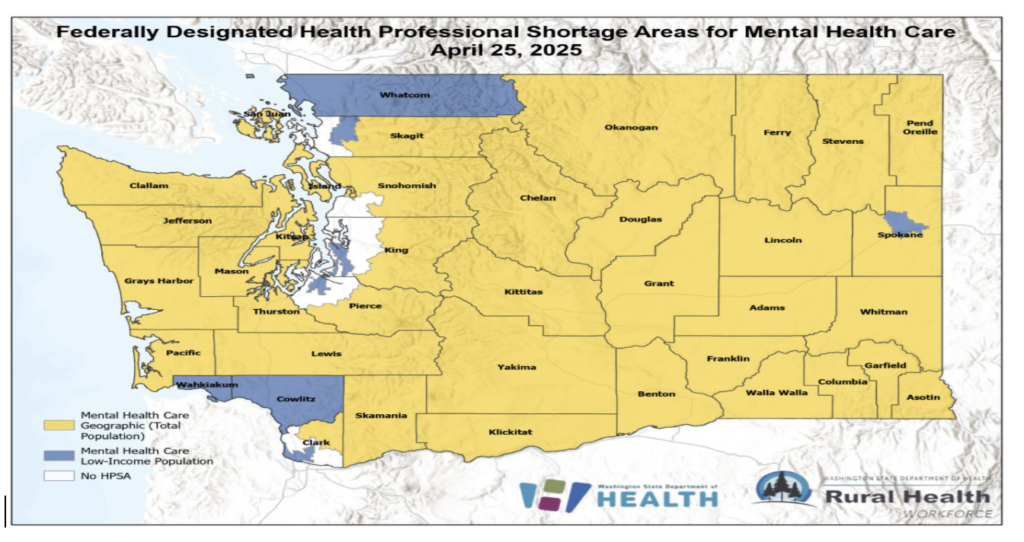
Map: Washington State Mental Health Professional Shortage areas (HPSAs), highlights regions where mental health provider shortages could make six‑month in‑person visits very difficult.
Patient’s homes can be considered an originating site.
Medicare rules generally only allow telehealth services to be provided from certain approved sites excluding a patient’s home. This requires traveling to places such as a physician’s office or a critical access hospital just to receive telehealth services seems unnecessary. This bill would allow a patient’s homes to be an eligible site from which they can receive telehealth services by removing geographic restrictions.
Medicare patients on hospice would be able to recertify hospice care via telehealth.
Currently, to keep receiving hospice care patients must be seen in person before the 180‑day recertification and every recertification after that. Removing the in-person requirement for recertification for hospice care would allow patients who are very ill to recertify without having to travel.
Jacqueline Edie: Pharmacist and Owner of Horizon Pharmacy & Goldendale Pharmacy

I had the privilege of interviewing Jacqueline Edie, a pharmacist, and the owner of 2 rural pharmacies in Southern Washington. Jacqueline provides services such as assessment and treatment for UTI’s, vaginal yeast infections, bites, stings, minor burns, pink eye, shingles and strep throat on top of normal pharmacy services. As a pharmacist, Jacqueline believes that having a presence in a rural community and being a trusted resource for patients is very important. Jacqueline explained that transportation issues are the biggest challenge that her rural patients face when trying to access healthcare. She stated that it can be around a 2-hour drive to a specialist, and even services that help with transportation are not always readily available.
She also went on to tell me that her pharmacies do not offer telehealth services, but that she can tell that more patients are utilizing telehealth services from the prescriptions that she receives. Although telehealth services can have its benefits, one downside that Jacqueline is currently facing is that she is having a much harder time trying to get a hold of telehealth providers than providers that are in person. However, Jacqueline believes that removing Medicare restrictions is overall a good thing!
Final Thoughts and Advocacy
Healthcare is something that should be accessible to all, yet there are Medicare recipients that still face significant barriers. Telehealth can help to bridge the gap faced by these recipients. Between the gaps highlighted by the Department of Health, my personal experience, and insight from Jacqueline Edie, it is evident that our healthcare system could benefit from having more flexibility. Telehealth can help ensure that patients continue to receive care when in person visits are not an option or too much of a burden. By removing outdated restrictions, the CONNECT for Health Act has the potential to make a significant impact. If passed, this could meaningfully expand access for patients in underserved areas. As student pharmacist, pharmacists, and community members we can advocate for Medicare recipients and rural health by educating people on the CONNECT for Health Act (HR 4206 / S. 1261), contacting legislatures to highlight the importance of the bill, and engaging in professional association efforts.
Sources
U.S. Congress. (n.d.) Search results for “CONNECT for Health”. https://www.congress.gov/search?q=%7B%22source%22%3A%22legislation%22%2C%22search%22%3A%22connect+for+health%22%7D
Washington State Department of Health. (n.d.). Mental health care shortage area map. https://fortress.wa.gov/doh/base/gis/mental.pdf